Sunday, July 19, 2020

Even inconveniences can bring blessings

This is a unique time. We are given the chance just like in Alma 33 in which people weren’t allowed to worship in the churches. What an opportunity to truly worship on our own without being seen of men. (Alma 33:7-8) It is a chance to flush out my individual desire to worship my Heavenly Parents and Savior and not just going to church to socialize. Although I do know that with every expectation we are given there are a multitude of benefits, and worshiping at a church with other people allows for the second blessing to be able to rub shoulders with other inspiring people. But for me, this time has afforded me the unique opportunity for an intrinsic experience that has fed my soul in ways that meeting in a congregation hasn’t. I am solely dependent on my own effort to experience communion with the Divine. I feel a new sense of self reliance as I connect with my Heavenly Parents without thinking about what I wear or if my hair looks okay to the people sitting behind me or consumed with what other people are wearing. It is all about feeling the Spirit and being inspired through my own efforts. It is true that with every inconvenience we can find blessings.  

Saturday, July 18, 2020

Never too late to change

Last night I listened to Roselyn Christensen’s funeral and was moved to tears and truly inspired. She was, without a doubt, a remarkable woman who influenced me in a multitude of ways. Funerals can be a great source of inspiration to be and do better. But if I am not careful, and only look back on my life instead of looking forward, listening to the stories of a well-lived, ambitious and faithful life can make me feel inadequate and stir up feelings of regret. I mean, this woman was “Mother of the Year” in 1990. I have often jokingly claimed that I was mother of the year in some random year when introducing myself when giving a speech somewhere, but this woman really was! 


At almost 65, I could think most of my life is behind me and feel like I have missed out on many opportunities that people such as Roselyn so beautifully took advantage of. Just listening to the musical experiences and the more than a dozen musical instruments found in their home, filled me with a sense that my family was woefully cheated. And those discouraging feelings can sabotage any ambition in the present moment.  


I am grateful for an eternal perspective that gives me hope that there is plenty of time for growth. That I can start right where I am and make changes that can bleed into eternity. Maybe I start with buying a drum set. Kev will love our grandkids banging on that. Thank you Roselyn for such a beautiful life and for your continued source of inspiration. And thank you to her children who were able to convey the lasting influence she had on them  and the love she offered to 10 accomplished children. 


May I also reference the hopeful message contained in Alma 23-29 about a blood thirsty people who changed dramatically to being a meek and faithful people. There is always hope for us. Change and new growth is always possible.


Sunday, June 21, 2020

Guilt
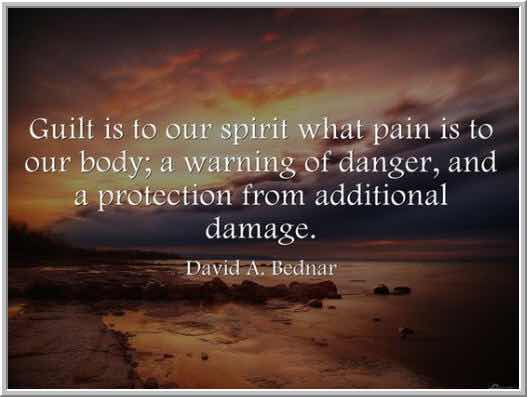

What needs to happen when we feel the pain of guilt is to quickly fall to our knees and repent. No excuse making, no justifying, no blaming; but just simply repent and seek the sweet release of the pain of guilt and open the door to a clear conscience and the opportunity to change and an opportunity for growth.


If we don’t seek that path then we become what the author of the book White Fragility so beautifully declared. “When we are mired in guilt, we are narcissistic and ineffective; guilt functions as an excuse for inaction.”


Picture that—mired in deep gooey mud and unable to move forward. We are stuck in a selfish predicament. Selfish because we can only think about ourselves and how hard life is at that moment. Of course, as my last post discussed, we could try hard to excuse and justify our behavior and try to place the guilt on other people, but that won’t free us from the muddy pit. We will only sink in deeper.


It is only when we admit our error and seek forgiveness from those we have wronged, especially our Creator, can we release the pain of guilt without being consumed by it, Just accept 100 percent responsibility and be cleansed. 


It really is a simple path that can bring us immediate relief. I know because I have been there. I have felt the excruciating pain of knowing that I am guilty of causing someone else a tremendous amount of pain and making my own life miserable. I was suddenly held accountable for something that I had wanted to believe was due to someone else’s sins. The guilt was truly painful. More than I could bare. But then, I did literally fell to my knees and I felt the immediate relief of being forgiven by my Savior. I felt the guilt melt away and I knew that I was completely loved by Him. I knew that my sins and my mistakes were swallowed up years ago in that Garden, and all I had to do was acknowledge my guilt and embrace that gift and thus be able to forgive myself. 


I say with complete conviction that the Atonement of Jesus Christ is real. It is powerful. And because of His gift, I don’t have to live with guilt. I can step out of the deep mud and move forward. I don’t have to be defined by my mistakes but I am given the opportunity to just learn from them.       


Saturday, June 6, 2020

100 Percent Responsible


I recently listened to a profound talk. “Be 100 percent Responsible” by Lynn G. Robbins. You can find it on the internet under BYU devotionals, and I highly suggest reading the talk directly but I just wanted to highlight a few quotes here for your reading enjoyment. :)

“Being 100 percent responsible is accepting yourself as the person in control of your life. If others are at fault and need to change before further progress is made, then you are at their mercy and they are in control over the positive outcomes or desired results in your life. Agency and responsibility are inseparably connected. You cannot avoid responsibility without also diminishing agency.” 

Do we realize how much freedom and power we give up when we try and hold someone else responsible for our own happiness???

Elder Robbins offers a detailed list of ways that we try to give up our responsibility and thus our freedom and power over our own lives. I appreciate how he has also linked stories in the scriptures that illustrates how valuable the lessons gleaned from the scriptures can be as we can learn from other people’s failings. 

1. Blaming others: Saul disobediently took of the spoils of war from the Amalekites; then, when confronted by Samuel, he blamed the people (see 1 Samuel 15:21).
2. Rationalizing or justifying: Saul then rationalized or justified his disobedience, stating that the saved livestock was for “sacrifice unto the Lord” (1 Samuel 15:21; see also verse 22).
3. Making excuses: Excuses come in a thousand varieties, such as this one from Laman and Lemuel: “How is it possible that the Lord will deliver Laban into our hands? Behold, he is a mighty man, and he can command fifty, yea, even he can slay fifty; then why not us?” (1 Nephi 3:31).
4. Minimalizing or trivializing sin: This is exactly what Nehor advocated (see Alma 1:3–4).
5. Hiding: This is a common avoidance technique. It is a tactic Satan used with Adam and Eve after they partook of the forbidden fruit (see Moses 4:14).
6. Covering up: Closely associated with hiding is covering up, which David attempted to do to conceal his affair with Bathsheba (see 2 Samuel 12:9, 12).
7. Fleeing from responsibility: This is something Jonah tried to do (see Jonah 1:3).
8. Abandoning responsibility: Similar to fleeing is abandoning responsibility. One example is when Corianton forsook his ministry in pursuit of the harlot Isabel (see Alma 39:3).
9. Denying or lying: “And Saul said . . . : I have performed the commandment of the Lord. And Samuel said, What meaneth then this bleating of the sheep in mine ears . . . ?” (1 Samuel 15:13–14).
10. Rebelling: Samuel then rebuked Saul “for rebellion.” “Because thou hast rejected the word of the Lord, he hath also rejected thee from being king” (1 Samuel 15:23).
11. Complaining and murmuring: One who rebels also complains and murmurs: “And all the children of Israel murmured against Moses and . . . said . . . , Would God that we had died in the land of Egypt!” (Numbers 14:2).
12. Finding fault and getting angry: These two are closely associated, as described by Nephi: “And it came to pass that Laman was angry with me, and also with my father; and also was Lemuel” (1 Nephi 3:28).
13. Making demands and entitlements: “We will not that our younger brother shall be a ruler over us. And it came to pass that Laman and Lemuel did take me and bind me with cords, and they did treat me with much harshness” (1 Nephi 18:10–11).
14. Doubting, losing hope, giving up, and quitting: “Our brother is a fool. . . . For they did not believe that I could build a ship” (1 Nephi 17:17–18).
15. Indulging in self-pity and a victim ­mentality: “Behold, these many years we have suffered in the wilderness, which time we might have enjoyed our possessions and the land of our inheritance; yea, and we might have been happy” (1 Nephi 17:21).
16. Being indecisive or being in a spiritual ­stupor: The irony with indecision is that if you don’t make a decision in time, time will make a decision for you.
17. Procrastinating: A twin of indecision is ­procrastination. “But behold, your days of probation are past; ye have procrastinated the day of your salvation until it is everlastingly too late” (Helaman 13:38).
18. Allowing fear to rule: This one is also related to hiding: “And I was afraid, and went and hid thy talent in the earth. . . . His lord answered and said unto him, Thou wicked and slothful servant” (Matthew 25:25–26).
19. Enabling: An example of enabling or ­helping others to avoid responsibility is the instance when Eli failed to discipline his sons for their grievous sins and was rebuked by the Lord: “Wherefore kick ye at my sacrifice and . . . honourest thy sons above me . . . ? (1 Samuel 2:29; see also verses 22–36).

In acknowledging that “excuses never equal results”, I especially like this quote attributed to David B. Haight: “A determined man finds a way; the other man finds an excuse.” 

Then Elder Robbins asks, “If the anti-responsibility list is so dangerous, why do so many people frequently turn to it? Because the natural man is irresponsible by nature, he goes to the list as a defense mechanism to avoid shame and embarrassment, stress and anxiety, and the pain and negative consequences of mistakes and sin. Rather than repent to eliminate guilt, he sedates it with excuses. It gives him a false sense that his environment or someone else is to blame, and therefore he has no need to repent.”

I know first hand the difference I feel inside when I try to ignore my need to repent by avoiding my responsibility, as opposed to when I humbly admit my fault and seek the joy the repentance truly brings. The truth is, true forgiveness cannot be accessed by calling someone else to repentance. I can only seek that for myself. And even if I don’t need to repent, I want to focus my energy on seeking solutions that I can control to better my situation. There is simply no power and there is no progress in remaining a victim to other people’s choices or the uncontrollable circumstances in my life.

By the way, don’t ever think my writings are only to benefit others. I am processing and writing to mostly convince myself of truths I need to better align with.   

Saturday, January 19, 2019

The Son Shines Through


I’ve learned something from watching sunsets and sunrises. They are a whole lot more majestic when there are dark clouds present. So it is in our lives. Christ’s example and influence is much more majestic through the dark clouds we experience. Just like the sunset and sunrise isn’t as spectacular without the clouds, His presence and influence doesn’t seem as important when there isn’t trouble in our lives. Thank goodness we do have the difficulties to help remind us how important and needful He is. Now we just need to get better at always basking in His goodness and direction when skies are clear.

Thursday, January 3, 2019

Responsible for our own Learning


So what does that mean that “we are responsible for our own learning”? Does it suddenly help us realize we can no longer claim, “church is boring.” That we can’t depend on people to just give us great talks in Sacrament meeting or provide stimulating lessons. That we are no longer just an audience waiting to be wowed. 

I realize we now have the renewed responsibility to learn from our own efforts. To learn how to gain not just knowledge but understanding. To make the understanding a part of us in a way that it changes behavior. And then to come to church reading and willing to share our insight and experience. To be an example of how gospel study can change our minds and hearts and lead us to Christ. 

I often think about what one of our sons experienced when he was on his mission in the MTC. He said they were all required to prepare a lesson as if they were going to be the teacher. Then they all showed up for class prepared and at that time they selected who would teach. Wouldn’t that then lend itself to a powerful discussion in which everyone was so well versed in the subject material? 

I had an amazing teacher and class in college—Dr. Herrin, Ecology of Family Belief Systems. If you have spent anytime with me and heard me reminisce about how that class impacted me for a life time, you aren’t hearing about this for the first time. 

Dr. Herrin (who incidentally was a member of The Church) would give us reading assignments before our class discussion. He would say that he really should require those who didn’t read the material to wait outside because they wouldn’t really have much to offer in the class discussion. (What if we did that at Sunday School?) No tests were given because it is evident that  just memorizing facts and regurgitating those facts only to eventually forget isn’t the way to true learning and understanding. 

We were just required to do a whole lot of reading, discussions, and a lot of writing about what we felt about what we read. And to add to this learning process, we were required to do a service learning project and then tie it into what we were learning. What I experienced and learned was incredible! And to this day, I remember so much of what I learned because it was a life-changing experience. It was true learning.

One of the most impactful learning I came away with from this class was about the process of true learning. It is more than listening and taking notes about what the teacher said and then being tested on his/her knowledge and how well I can recite back. It was a process is which I had to be an active participate. I learned how important it is for me to do my own processing by really coming to my own personal understanding and articulating it in writing. I experienced the profound lessons that are taught in service learning. That I can’t just learn something but I have to do something about what I have learned. Yes, I learned that I am responsible for my own learning and how that learning should be used to bless others. And I learned that I want to keep learning for a liftetime because of how intrinsically rewarding it is. 

A Higher Standard


I have always believed that when there is trouble in a relationship or a culture that I must ask, “Is it I?” It is always so easy and natural to want to blame someone else; but time and time again I realize I am a big part of the problem and if I want things to change, I have to hold myself to a higher standard and I have to change.

I usually just want to call out my own sins but I want to speak out about a need for universal higher standards. I look around and want all of us to take personal responsibility and be held to a higher standard, especially when there is trouble in a society. 

I am sad and frustrated about the example of those in public office and newscasters who aren’t holding themselves to a higher standard. Anderson Cooper and Don Lemon have justifiably expected our current president to be held to a higher standard, but then I was gravely disappointed as I watched these same newscasters ignore the professionalism of their role and behave in what I deem reckless behavior on New Years Eve. I can’t for a millisecond imagine the respected newscasters of the past, such as Walter Cronkite, getting inebriated on the air. 

As Anderson Cooper and Don Lemon have repeatedly and justifiably held our president to the higher standards of past presidents, I simply ask them to embrace the higher standards of past newscasters as well. We all have a responsibility to take a hard look at ourselves and assess whether we are contributing to the social problems and the social climate of our day. Drunkenness simply doesn’t benefit our society.